Tenaga Nasional Berhad (TNB) has entered into a strategic partnership with Port of Tanjung Pelepas (PTP), a member of the MMC Group, to support Malaysia’s decarbonisation agenda and enhancing sustainability compliance through greater renewable energy adoption under the Green Electricity Tariff (GET) programme.
The partnership brings together TNB’s access to certified renewable energy and PTP’s strong commitment to decarbonising its operations, demonstrating how existing national infrastructure can support businesses in advancing their sustainability goals and reducing emissions.
Under the partnership, PTP subscribed to 16,000 blocks of GET, equivalent to 16 GWh of certified green energy per month, for the period from May 2026 to December 2027. The subscription makes PTP the largest GET subscriber among Malaysian ports to date and enables the port to transition its electricity supply to 100% renewable energy.
The GET programme allows TNB customers to power their premises with certified renewable energy. Subscribers pay a normal base tariff plus a tiered green premium, receiving annual Malaysia Renewable Energy Certificate (mREC).
Tenaga Nasional Berhad (TNB) welcomes the initiatives under the MADANI Budget 2027, which emphasise consumer protection, strengthening of the National Grid, electricity supply security and sustainable energy development as foundations for economic growth and the
well-being of rakyat.
The expansion of electricity bill protection for domestic consumers, investments to strengthen the National Grid and efforts to broaden access to clean energy underscore the importance of developing energy infrastructure that can meet the country’s growing needs.
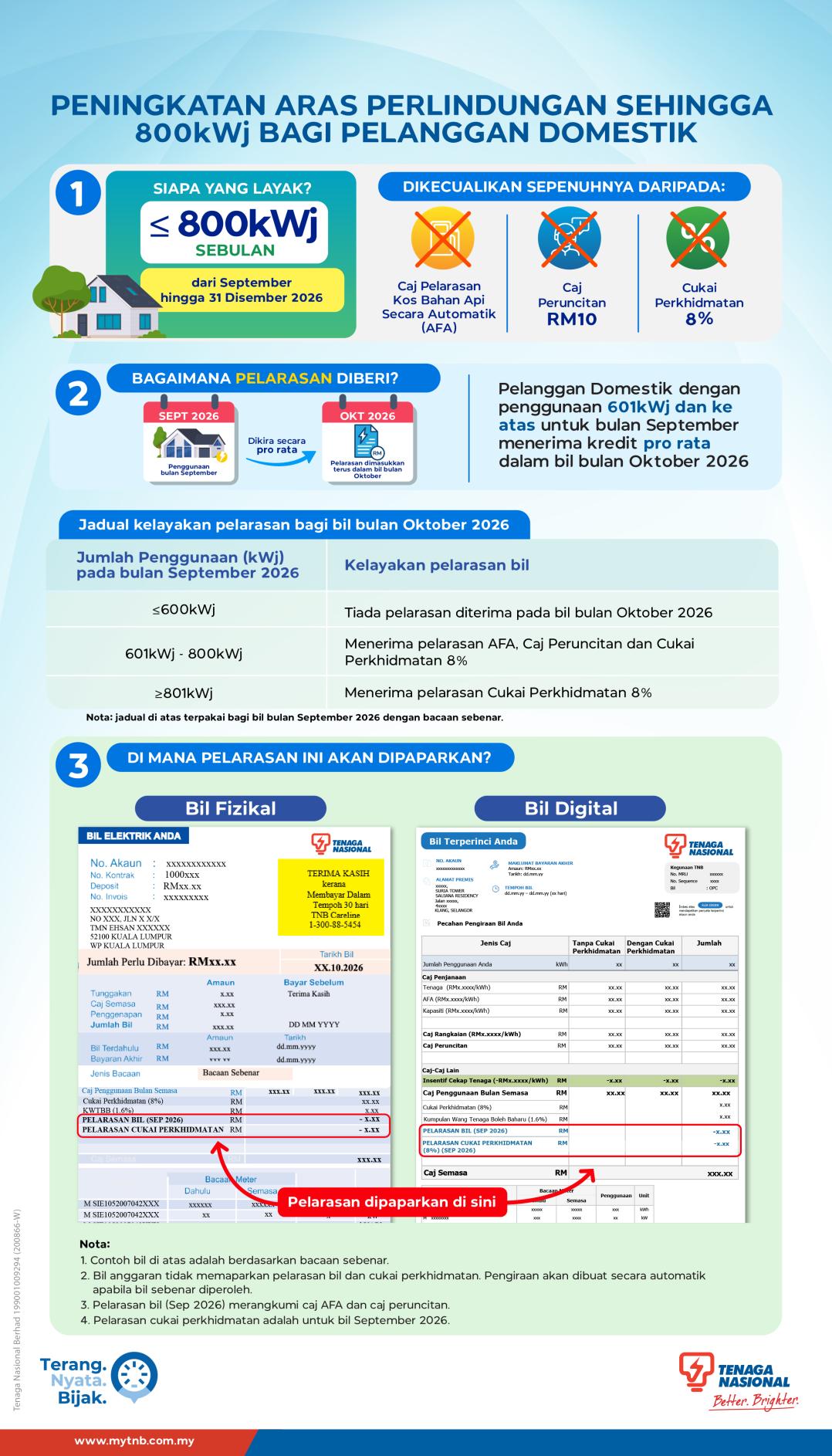
Lanjutan daripada pengumuman kerajaan pada 17 September 2026 untuk menaikkan aras perlindungan pelanggan Domestik daripada 600kWj sebulan kepada 800kWj sebulan, Tenaga Nasional Berhad (TNB) ingin menerangkan kaedah pengkreditan manfaat tersebut bagi penggunaan bulan September.
Menerusi peningkatan aras perlindungan berkenaan, pelanggan Domestik dengan penggunaan 800kWj dan ke bawah sebulan bagi tempoh September hingga 31 Disember 2026 akan menikmati pengecualian sepenuhnya daripada:
- Caj Pelarasan Kos Bahan Api Secara Automatik (Automatic Fuel Adjustment – AFA),
- Caj Peruncitan RM10,
- Cukai Perkhidmatan 8%.
Bagi pelanggan yang layak, pelarasan caj-caj di atas untuk bulan September akan dikira secara pro rata dan dikreditkan terus ke dalam bil bulan Oktober 2026. Jumlah pelarasan tersebut akan dipaparkan di dalam bil pelanggan di bawah butiran “PELARASAN BIL (SEP 2026)” dan “PELARASAN CUKAI PERKHIDMATAN (8%) (SEP 2026)”.
Tenaga Nasional Berhad (TNB) wishes to inform all vendors that the Purchase Order Terms & Conditions (Edition 2026) has been implemented with immediate effect.
The PO T&C 2026 applies to Purchase Orders without GCC. For Purchase Orders issued with Contract Conditions, the applicable terms shall continue to be governed by the relevant contract, including GCC, PCC and/or other terms and conditions agreed between TNB and the Vendor.
Vendors are advised to review and familiarise themselves with the updated terms and conditions.
Please click the links below to view/download the documents:
- Purchase Order Terms and Conditions (Edition 2026) - English | Bahasa Melayu
Thank you for your continued cooperation and support.
Supplier Relationship Management
Procurement & Supply Chain
Tenaga Nasional Berhad
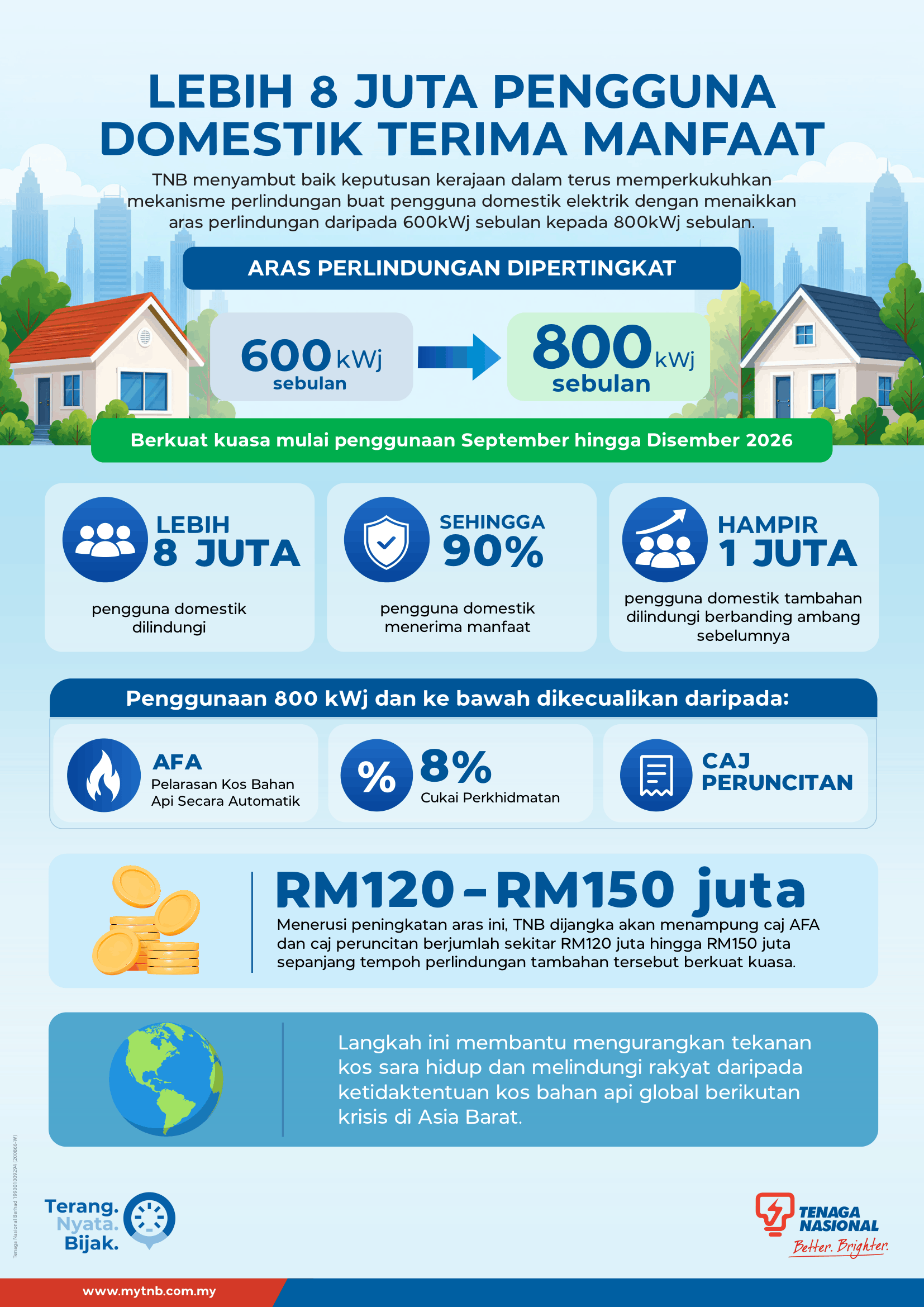
Susulan pengumuman Kerajaan pada 17 September 2026, aras perlindungan bil elektrik bagi pelanggan domestik telah dinaikkan daripada 600 kWj kepada 800 kWj sebulan.
Pengukuhan perlindungan tambahan ini berkuat kuasa bagi penggunaan elektrik dari 1 September hingga 31 Disember 2026. Pelanggan domestik dengan penggunaan 800 kWj dan ke bawah sebulan akan menikmati pengecualian berikut:
- Pelarasan Kos Bahan Api Secara Automatik (AFA)
- Caj Peruncitan
- Cukai Perkhidmatan
Tenaga Nasional Berhad (TNB) mengambil maklum mengenai kebimbangan segelintir pengguna berkenaan bil elektrik, terutamanya berkaitan komponen Pelarasan Kos Bahan Api Secara Automatik (Automatic Fuel Adjustment – AFA). Kami memahami bebanan kos sara hidup dan ingin menjelaskan bagaimana mekanisme AFA berfungsi dan langkah-langkah yang telah dilaksanakan bagi melindungi pengguna.
AFA diperkenalkan bermula 1 Julai 2025 berikutan penstrukturan tarif elektrik sebagai ganti kepada mekanisme Imbalance Cost Pass-Through (ICPT). Justeru, AFA bukan caj tambahan baharu dan ianya tidak menyalurkan keuntungan terhadap TNB. AFA berfungsi sebagai mekanisme dua hala untuk mengimbangi perubahan kos bahan api dan kadar tukaran wang asing.
Tenaga Nasional Berhad (TNB) continues to strengthen its role as Malaysia Energy Literacy Program’s (MELP) strategic partner by bringing energy education and awareness closer to the public, particularly the rural communities.
This commitment was demonstrated through the ‘MELP Bersama Komuniti Mukim Cheka 1’ program in Kuala Lipis, Pahang, which gathered around 600 residents from nine villages. The program provided a platform for local community to enhance their knowledge on energy management, promote safer and more efficient electricity consumption practices, and foster two-way engagement between TNB and the community.
The half-day program also involved around 100 primary school pupils through a sustainable energy-themed colouring contest, alongside knowledge-sharing and interactive sessions with the community.
As part of the program, TNB also contributed RM75,000 in corporate social responsibility to schools, mosque and surau, as well as welfare organisations around Mukim Cheka 1.
The program held today was attended by Energy Transition and Water Transformation Deputy Minister, Dato' Sri Haji Abdul Rahman Haji Mohamad, who is also MELP National Steering Committee Chairman. Also present, Ministry of Energy Transition and Water Transformation Deputy Secretary General (Energy), Mareena Mahpudz; TNB Chief Retail Officer, Datuk Kamal Arifin A. Rahman; and TNB Chief Regulatory and Stakeholder Management Officer, Shahannom Izham.
Dato’ Sri Haji Abdul Rahman said energy literacy is an important foundation in shaping a society that is able to make smarter energy choices and play a role in advancing the national energy transition agenda.
“Energy transition cannot rely solely on policies, technology and investments. Thus, programs such as MELP need to reach communities at the grassroots level, including rural communities, so that they understand the changes in energy landscape and aware on how they can play their part,” he added.
TNB Commences Development Of 500kV National Grid Backbone, Reinforcing Malaysia’s Energy Security and Transition
Tenaga Nasional Berhad (TNB) marked another significant achievement in its commitment to building a future-ready energy infrastructure with the commencement of a new 500kV National Grid Backbone transmission line – a strategic infrastructure project that will reinforce national energy security, accelerate energy transition and accommodate the nation’s future electricity needs.
The launching of the 500kV Transmission Main Intake Substation (PMU) Kampung Awah project site in Maran, Pahang, today marks an important milestone in the development of the National Grid Backbone, which will connect strategic locations across the east coast of Peninsular Malaysia.
The National Grid Backbone is designed to enhance the resilience, reliability, flexibility and transmission capacity of the National Grid, while advancing the implementation of the National Energy Transition Roadmap (NETR).
Upon its completion by 2030, the National Grid Backbone is set to become the longest 500kV transmission system to ever be developed in Malaysia with a total length of approximately 500km.
The launching of PMU Kampung Awah project site was officiated by Pahang Menteri Besar, Dato’ Sri Diraja Wan Rosdy Wan Ismail, and attended by TNB President/Chief Executive Officer, Datuk Ir. Ts. Shamsul Ahmad.
Tenaga Nasional Berhad (TNB) continued to demonstrate resilient performance for the first half of the financial year ended 30 June 2026 (1H 2026), reaffirming its ability to deliver reliable and secure electricity, strengthening national energy security and advancing Malaysia’s energy transition amid a dynamic global energy landscape.
Against the backdrop of global energy market volatility, increasing electricity demand and evolving energy transition requirements, TNB remained focused on maintaining operational excellence, supported by disciplined financial management and strategic execution of its integrated business model.
TNB President/Chief Executive Officer, Datuk Ir. Ts. Shamsul Ahmad, said this resilience enabled TNB to continue investing in Malaysia’s energy ecosystem while delivering values to its stakeholders.
“Our 1H 2026 performance enables us to continue investing in critical infrastructure that not only powers households and businesses, but also strengthens national energy security, accelerates energy transition, and ensure we continue delivering reliable and secure electricity while creating value for our customers, shareholders and the nation,” he said.
McDonald’s Malaysia and Tenaga Nasional Berhad (TNB) are strengthening their strategic partnership to bring cleaner energy and green mobility closer to where people live, work and travel, while helping businesses and communities participate in Malaysia’s transition towards a cleaner and more sustainable energy future.
One partnership. Three solutions. One shared ambition — making the energy transition practical and accessible. The partnership brings together three complementary solutions — rooftop solar through the Supply Agreement with Renewable Energy (SARE), renewable electricity through TNB’s Green Electricity Tariff (GET), and green mobility through TNB Electron EV charging — enabled by TNB’s wider energy ecosystem and grid infrastructure.
The collaboration, witnessed by Chief Minister of Penang, YAB Tuan Chow Kon Yeow, is marked by the signing of the SARE agreement for the next phase of McDonald’s solar rooftop programme, the presentation of the GET certificate, and the official launch of the TNB Electron EV charging facility at McDonald’s Batu Kawan Drive-Thru.
The partnership also supports Malaysia’s broader energy-transition and energy-efficiency ambitions, including the National Energy Transition Roadmap (NETR) and the National Energy Efficiency Action Plan (NEEAP) 2.0, while contributing to Penang’s Energy Framework.