-
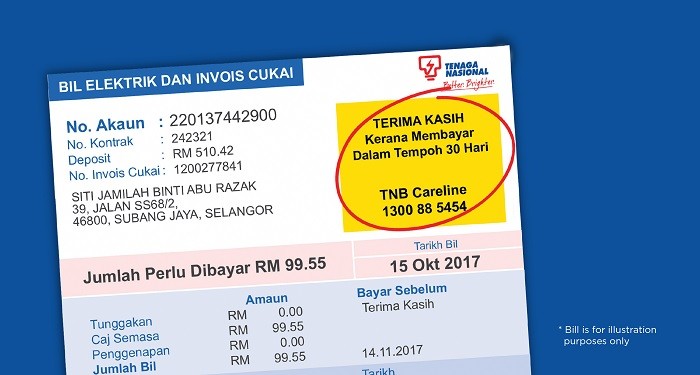
Station Code
Possesses 4 digits and refers to a specific TNB station.
-
Account Number
Possesses 10 digits and refers to the account numbers of each customer (including 2 check digit).
Example:
0123 Station Code
00000100 Customer’s Number
00 Check Digit
-
Deposit
Refers to the deposit which is compulsory for every customer prior to connection of supply. The amount is based on the average of six (6) months electricity consumption. Normally, the total deposit shall not be less than twice the average monthly consumption. (Please refer to the Deposit section for more details)
-
Name and Customer’s Registered Address
Registered customer’s name with TNB and the address where electricity supply is being connected.
-
Code – (example: CASH)
This means that the customer has paid the deposit to TNB in cash. Cash deposit qualifies for a 5% rebate of the total deposit annually at the beginning of the year.
-
Bill Number
Every printed bill has a different bill number.
-
Reading Unit
Identifies the reading area.
-
Bar Code
Bar code for the customer’s account number.
-
Description
This column includes the date and amount of the previous billing as well as the date and the latest payment made by the customer.
-
Type of Reading in the previous month
A – Average billing (damage period - average)
E – Estimated billing
N – Actual reading billing (normal)
O – Office billing
-
Tariff Cost
The stated tariff rate is based on the tariff code given to the customers.
-
Additional Deposit
The customer has to pay deposit sufficient for two (2) months. If the usage increases, the TNB billing system will automatically calculate the additional deposit amount payable by the customer. The amount shall be displayed in this column. (Please refer to the Deposit section for more details)
-
Outstanding Amount
Total outstanding amount based on the date of TNB billing.
-
Payment Received Until Now
The total payment received until now.
-
Phase Number
Phase number is the number which can be found on the phase of the customer’s premise.
-
MF
Refers to the phase’s total factor, MF or multiplying factor. For ordinary power consumers, the MF is one (1). If it is other than 1, then it is wrong. For large power consumers, the MF depends on the size and type of phase installed.
-
Previous
Reading for the previous month.
-
Latest
The reading on date the meter is read.
-
Usage
Refers to the total unit utilised, measured in kWh.
-
Charge
Description regarding the type of charges imposed.
-
Unit
Refers to the total unit billed
-
Rate
Refers to the rate imposed following the specific tariff code.
-
Amount
Refers to the billed amount based on the charges’ descriptions.
-
Electricity Amount
Refers to the actual amount of unit charge and maximum required charge (if any) for the existing month’s utilisation.
-
Other Charges
Refers to the other additional charges (if any), for example, charges for temporary supply and power factor surcharge.
-
Estimated adjustment
Adjustment on the previous month’s estimated billing (if any).
-
Others
Refers to the charges for phase testing, damaged phase, special reading and others (if any).
-
Penalty
Refers to late payment penalty. After 30 days of the billing date, a penalty of 1 % will be imposed.
-
Latest Bill
The overall amount of the items on the left side of the bill.
-
Outstanding Amount
Total outstanding amount based on the date of TNB billing.
-
Additional Deposit
If there is any additional deposit due.
-
Total Amount Payable
Current charge includes arrears and other charges (if any).
-
The Date of Meter Reading and Bill Issued to the Customer
-
Telephone number for reporting outages
(Telephone / SMS to 1-5454 – TNB Service Line / TNB Careline)
-
Address of the Nearest TNB Office that Issued the Bill
-
Final Date for Payment