Thermal power generation remains an important part of Malaysia’s electricity system, supporting reliability and energy security as the country advances its energy transition. At the same time, coal- and gas-fired generation produces regulated air pollutants that must be carefully monitored and managed.
For Tenaga Nasional Berhad (TNB), managing air emissions is therefore an integral part of responsible plant operations. Across its thermal generation portfolio, TNB combines continuous monitoring, emission-control technologies, operational improvements and longer-term portfolio transition to progressively reduce its environmental footprint.
This approach is underpinned by TNB’s environmental policy, which provides guidance for managing environmental impacts and enabling continuous improvement across its operations. For air emissions, the policy is supported by a defined emissions reduction strategy that combines technology, operational improvements and portfolio transition, together with initiatives aimed at progressively reducing key air pollutants over time.
Towards 2035, these initiatives include the progressive retirement of older assets, improvements in plant efficiency and the introduction of cleaner generation technologies to support a lower-emission generation portfolio.
Performance Against Malaysia's Clean Air Standards
Malaysia's Environmental Quality (Clean Air) Regulations 2014 set limits on the amount of air pollutants that power plants can release. These requirements vary according to plant type and fuel used, providing the regulatory benchmark for TNB's thermal operations.
Coal- and gas-fired plants have different emissions profiles. Coal-fired generation produces a broader range of regulated pollutants, including sulphur dioxide (SO₂), nitrogen dioxides (NO₂), carbon monoxide (CO) and particulate matter (PM), while gas-fired generation is primarily associated with NO₂ and CO. Within coal-fired generation, SO₂ is a key contributor, influenced by factors such as the sulphur content of the fuel and the performance of emission-control systems.
TNB manages these emissions through a combination of continuous monitoring, combustion optimisation and dedicated control technologies, including Flue Gas Desulphurisation (FGD) and Electrostatic Precipitators (ESP).
| Plant Name | Fuel Type | Pollutants | CEMS | FGD | ESP | Dry Low Nox Burners |
|---|---|---|---|---|---|---|
| Tuanku Ja’afar Power Station | Gas | NO₂, CO | ✔ | ✔ | ||
| Gelugor Power Station | Gas | NO₂, CO | ✔ | |||
| Putrajaya Power Station | Gas | NO₂, CO | ✔ | |||
| Sungai Perak Hydro Scheme3 | Hydro | |||||
| Kenyir Hydro Scheme4 | Hydro | |||||
| Cameron’s Hydro Scheme5 | Hydro | |||||
| Sultan Azlan Shah Power Station, Unit 1-3 | Coal | NO₂, CO, SO₂, PM | ✔ | ✔ | ✔ | |
| Sultan Azlan Shah Power Station, Unit 4 (M4) | Coal | NO₂, CO, SO₂, PM | ✔ | ✔ | ✔ | |
| Sultan Azlan Shah Power Station, Unit 5 (M5) | Coal | NO₂, CO, SO₂, PM | ✔ | ✔ | ✔ | |
| Tuanku Muhriz Power Station (JEP) | Coal | NO₂, CO, SO₂, PM | ✔ | ✔ | ✔ | |
| Sultan Salahuddin Abdul Aziz Power Station (KEV) | Gas/Coal | NO₂, CO, SO₂, PM | ✔ | ✔ | ||
| Perai Power Station | Gas | NO₂, CO | ✔ | ✔ | ||
| Connaught Bridge Power Station | Gas | NO₂, CO | ✔ | ✔ | ||
| Sultan Ibrahim Power Plant | Gas | NO₂, CO | ✔ | ✔ |
Table 1: TNB's Operating Generation Portfolio and Emissions Control Technologies
Continuous Monitoring Provides the Foundation
Central to TNB’s approach is the use of Continuous Emission Monitoring Systems (CEMS) across all its thermal plants.
CEMS continuously measures pollutants released through power-plant stacks, providing plant operators with timely information on emissions performance.
This visibility allows operating teams to monitor changing conditions, optimise plant performance and support environmental reporting requirements. It also provides an important feedback mechanism for assessing whether pollution-control technologies are operating effectively.
In this way, emissions management begins with measurement. Accurate and continuous monitoring enables plant teams to understand where emissions are generated, how operating conditions influence them and where improvements can be made.
Technology at the Source and Before Release
Building on this monitoring foundation, TNB applies different emission-control technologies according to the type of plant and pollutant being managed.
For nitrogen oxides (NOx), TNB applies combustion control technologies tailored to different plant types. Dry Low NOx burner (DLN) technology is incorporated in all new gas-fired plants. This technology helps reduce the formation of NOx during combustion by controlling fuel-air mixing, flame temperature and combustion conditions.
TNB’s own operational comparison illustrates the effectiveness of DLN technology. Selected Tuanku Ja’afar Power Station units equipped with DLN recorded NO₂ concentrations of around 34 to 40 mg/m³, demonstrating substantially lower emissions compared with selected units without DLN.
This approach is increasingly being embedded at the procurement stage, with low-emission combustion technology and high thermal efficiency considered when new gas turbines are acquired.
For coal-fired generation, TNB employs two key post-combustion control technologies.
Electrostatic Precipitators (ESP) remove particulate matter from flue gas using electrical charges before the treated gas is released through the stack.
Flue Gas Desulphurisation (FGD) systems remove sulphur compounds from flue gas to reduce SO₂ emissions.
The impact of FGD is also evident in TNB’s plant comparisons. Sultan Azlan Shah Power Station Generating Facility 1, which is equipped with FGD, recorded an SO₂ concentration of approximately 180 mg/m³, compared with substantially higher concentrations at selected coal units without FGD.
Together, these technologies provide multiple layers of control: reducing pollutants during combustion where possible and capturing or treating them before release where necessary.
Strengthening Performance Through Operations and Maintenance
Technology alone does not determine emissions performance. TNB complements its emission-control systems with operational practices designed to reduce pollutant formation and maintain the effectiveness of installed controls. This is supported by plant-by-plant analysis of air emissions performance, enabling mitigation measures to be tailored to the operating and emissions profile of each thermal asset.
This includes improving boiler tuning, optimising air-fuel ratios and refining furnace-control strategies. Better combustion control can help reduce the formation of NOx and CO while improving overall fuel efficiency.
Fuel quality is another important consideration, particularly for coal-fired generation. Using lower-sulphur coal or appropriate coal blends can reduce SO₂ formation at source before flue-gas treatment is required.
Preventive and predictive maintenance programmes are also being strengthened for key pollution-control equipment, including FGD systems, ESPs and burners. CEMS calibration and data-integrity protocols further support reliable emissions measurement and environmental reporting.
TNB’s approach therefore combines several measures rather than relying on a single intervention - better combustion, appropriate fuel selection, reliable control equipment, continuous monitoring and disciplined maintenance.
From Emission Control to Portfolio Transition
While operational controls remain essential for existing plants, the longer-term trajectory of air emissions will increasingly be shaped by changes in TNB’s generation portfolio. As older thermal assets are progressively retired and newer, more efficient technologies enter the system, overall air-pollutant loading is expected to decline over time.
The most significant structural reductions are expected in pollutants associated with coal generation. Under TNB’s 2035 base-case projections, SO₂ declines from approximately 111,140 tonnes in 2025 to 28,472 tonnes in 2035, while particulate matter decreases from approximately 6,463 tonnes to 2,430 tonnes. NO₂ is also projected to decline more gradually, reflecting the continued role of gas-fired combined-cycle generation.
These projections provide a quantified reduction pathway for TNB’s thermal portfolio. Progress towards 2035 is already supported by emission-control and low-emission technologies deployed across selected plants, including FGD and ESP systems, Low NOx burner and DLN systems, together with ongoing operational improvements.
At the same time, newer combined-cycle gas turbine plants are expected to operate with lower pollutant concentrations, supported by higher thermal efficiency and Dry Low-NOx combustion technologies.
This illustrates an important shift in TNB’s emissions management approach. Over time, cleaner air performance will increasingly be achieved not only through equipment installed at individual plants, but through the transition of the generation portfolio itself.
TNB’s Projected Structural Emission Reductions (2025–2035)
| Year | Annual SO₂ Loading (Tonnes) | PM Emissions (Tonnes) |
|---|---|---|
| 2025 (Current Baseline) | 111,140 | 6,463 |
| 2035 (Estimated) | 28,472 | 2,430 |
| Estimated Percentage of Improvement | 74.4% | 62.4% |
Managing Today's Operations While Preparing for Tomorrow
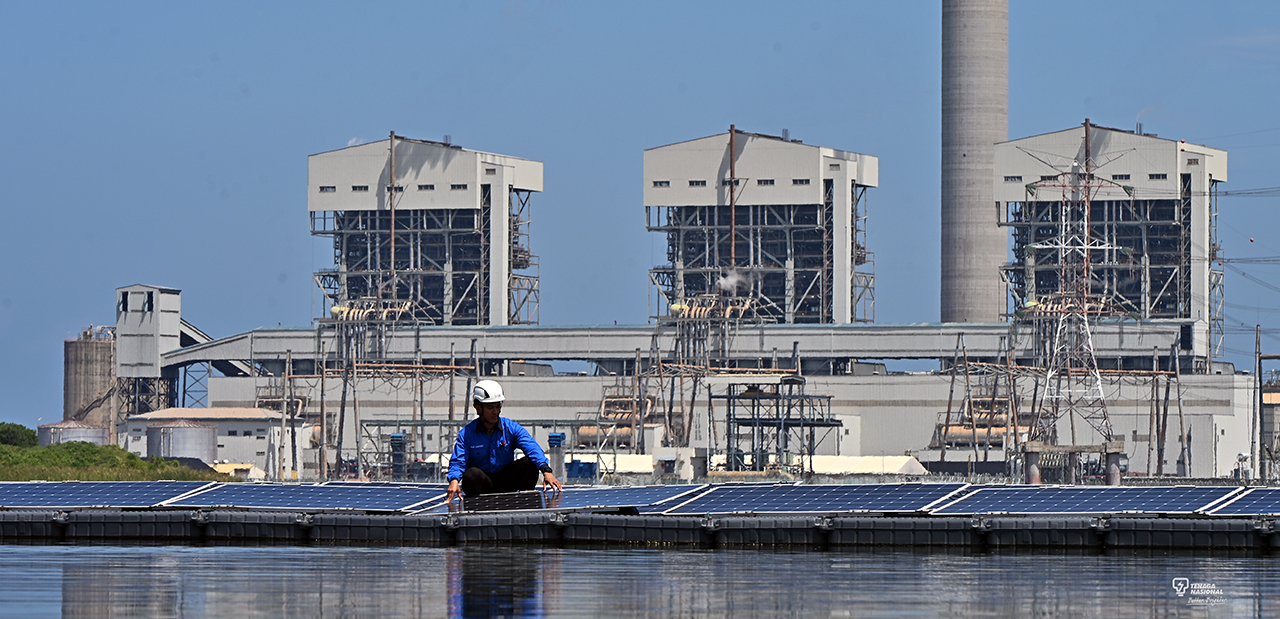
For TNB, managing air emissions involves both operating today’s thermal assets responsibly and preparing the generation portfolio for a lower-emission future. Continuous monitoring, targeted emission-control technologies and operational improvements support performance at existing plants, while the progressive transition towards newer and more efficient generation technologies is expected to reduce the portfolio’s overall emissions profile over time.
Taken together, these efforts reflect an integrated approach to environmental management by combining measurement, mitigation and portfolio transition to support reliable electricity generation while progressively reducing environmental impact.