Malaysia's Climate Ambition: A Shared Responsibility
Malaysia has strengthened its commitment to combating climate change through the National Climate Change Policy 2.0, which sets the direction for a low-carbon and climate-resilient economy. In alignment with the Paris Agreement, the United Nations 2030 Agenda, and the nation's Nationally Determined Contribution (NDC), Malaysia aims to reduce its economy-wide absolute emissions by 15 to 30 million tonnes by 2035 from peak levels and achieve Net Zero by 2050.
As the nation's economy progresses, electricity demand has shown consistent growth. From 2018 to 2025, Malaysia's GDP grew at a Compound Annual Growth Rate (CAGR) of 3.52%, whilst absolute emissions CAGR remained at approximately 1.47%. This demonstrates that emissions growth has been contained at a lower rate compared to GDP growth, supporting progress towards a greener fuel mix.
Malaysia GDP compared with TNB Absolute Emission
Year
Figure 1: Malaysia’s GDP as compared to TNB’s Absolute Emissions
As Malaysia's national electricity provider, TNB recognises its responsibility to enable and support the country's energy transition whilst delivering secure and reliable electricity. Accounting for approximately 48.8% of total generation capacity in Peninsular Malaysia, TNB supports Malaysia's effort to balance the energy trilemma of energy security, affordability, and sustainability through its Energy Transition Plan. This plan spans the entire energy value chain, encompassing the transition to clean energy sources, development of energy transition networks, and delivery of innovative customer solutions that promote efficient energy usage.
Navigating a Complex Energy Market
As the energy transition continues to evolve, external factors such as geopolitical uncertainties and global energy market disruptions present increasingly complex challenges in balancing decarbonisation with the need for reliable and affordable electricity.
Constraints on fuel supply and price volatility arising from geopolitical tension in the Middle East have reinforced the importance of maintaining a resilient and secure energy system. As the national utility, we continue to work closely with the Government and regulators to optimise the energy mix, ensuring energy security while managing cost and reliability. The use of conventional energy resources during periods of energy crisis helps maintain stable electricity access, thereby sustaining economic and social continuity.

Illustration of global energy market disruption
TNB advances its decarbonisation efforts within a challenging and dynamic operating environment. Electricity demand in Peninsular Malaysia is projected to grow at over 5% annually towards 2030, driven by economic expansion and data centre developments. Simultaneously, geopolitical uncertainties have contributed to volatility in global energy markets, affecting Malaysia's gas supply reliability and pricing.
As Peninsular Malaysia's grid operates on a least-cost dispatch principle, increased demand and higher gas prices have escalated reliance on coal-based generation to maintain supply security while managing cost impact to consumers. This has contributed to emissions exceeding earlier projections and necessitated a reassessment of decarbonisation pathways and transition strategies.
Nevertheless, TNB remains committed to its Net Zero aspiration, supported by strategic energy resource planning and close collaboration with regulators, policymakers and industry partners to ensure the transition remains inclusive, equitable and resilient amid evolving geopolitical and market conditions. This evolving landscape also provides an opportunity to reassess long-term resource planning, including accelerating renewable energy and exploring cleaner alternatives such as nuclear energy to support a resilient and low-carbon power system.
Recalibrating Our Decarbonisation Initiatives
TNB's Carbon Management Strategy and Renewable Energy Expansion Plan guide the Group's journey towards Net Zero emissions by 2050. The strategy is anchored on three pillars: Reduce, Capture, and Offset, targeting a 5% annual reduction in GHG emissions intensity from 2024, supporting a 35% reduction by 2035 and Net Zero by 2050.
Carbon Management Strategy
Three (3) carbon management strategies:
Carbon Emissions (tCO2e)
Carbon Emissions Intensity (tCO2e/MWh)
Renewable Energy Capacity Expansion
Capture RE growth potential in domestic and international markets:
- Large Scale Solar (LSS)
- Corporate Green Power Programme (CGPP)
- NETR* (Solar park & Hybrid Hydro-Floating Solar)
- Third-Party Access (TPA)
- Capture United Kingdom market through Vantage RE.
- Capture Australia market through Spark Renewables
Embark on strategic partnership for new technology, e.g., grid-scale BESS.
RE Capacity (MW)
Net Generation from RE (MWh)
*NETR: National Energy Transition Roadmap
In view of prevailing geopolitical uncertainties and rising electricity demand, a strategic review of emissions reduction initiatives for the 2026–2030 period has been undertaken. Scenario analysis has been conducted to assess projected electricity demand growth, opportunities for renewable energy capacity expansion, new generation plant development and the potential extension of thermal plant operations, taking into consideration both internal and external factors influencing the emissions projections. The review also evaluated the viability and effectiveness of existing emissions intensity reduction initiatives amid evolving market and operational conditions.
Whilst TNB maintains its overall strategy and targets, certain initiatives have been recalibrated, with enhanced focus on accelerating renewable energy capacity expansion towards 2030. Despite short-term constraints, TNB remains committed to the annual 5% emissions intensity reduction through identified initiatives, excluding external factors beyond its operational control.
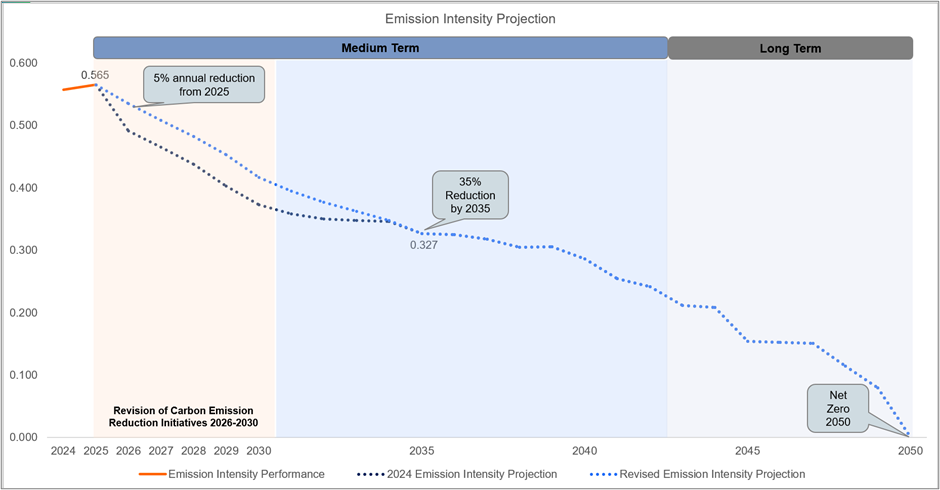
Figure 2: TNB’s emissions intensity projection
Delivering Measurable Progress in Emission Reduction
Despite growing electricity demand and ongoing energy market uncertainties, TNB continues to make meaningful progress in reducing emissions intensity, demonstrating that decarbonisation and economic growth can progress concurrently.
As of Q1 2026, identified decarbonisation initiatives including power plant efficiency improvements, coal blending, coal combustion additive, microalgae initiatives, optimisation of renewable energy generation from domestic and international assets, as well as solar rooftop installations have collectively contributed to a 3.06% reduction in emissions intensity to 0.5477 tCO₂e/MWh. Nevertheless, higher gas prices and tighter gas market conditions linked to geopolitical developments in the Middle East have increased reliance on coal-fired generation. As a result, overall emissions intensity increased to 0.575 tCO₂e/MWh.
Leading a Balanced Energy Transition
TNB's role in Malaysia's power sector places it at the forefront of the country's energy transition. Whilst demand growth and energy market uncertainties present structural challenges, TNB has demonstrated clear progress, a credible strategy, and strong alignment with national and regional frameworks. Through disciplined execution of the Carbon Management Strategy and Renewable Energy Expansion Plan, TNB supports a balanced, equitable and resilient transition that enables economic growth whilst advancing towards a low-carbon future.