It is easy to picture the energy transition as a story about machines: new turbines, cleaner fuels, smarter grids. But every one of those machines is designed, switched on, maintained, financed and improved by people. The transition succeeds or stalls on one question: are our people ready for it?
For Tenaga Nasional Berhad (TNB), that question sits at the heart of a Just Transition, making sure our people are equipped to take part fully in the shift to a low-carbon energy future, and that no employee, and no part of our workforce, is left behind. A Just Transition is not only about preparing people for new technology. It is about giving them the knowledge, the skills and the confidence to meet changing responsibilities, new risks and fresh opportunities head-on.
Building capability for the transition
To turn that commitment into action, TNB established the Energy Transition and Sustainability Academy (ETSA) under TNB Integrated Learning Solution Sdn. Bhd. (ILSAS), a Group-wide platform built to institutionalise the capabilities our transition demands, at scale.
ETSA is anchored to Reimagining TNB 2.0 and our Net Zero 2050 aspiration, connecting TNB’s energy transition and sustainability ambitions to real, practical learning for the people who deliver them. It builds on our earlier efforts to embed energy transition learning while broadening the scope to cover sustainability reporting, climate risk, and the wider social and economic dimensions of the transition.
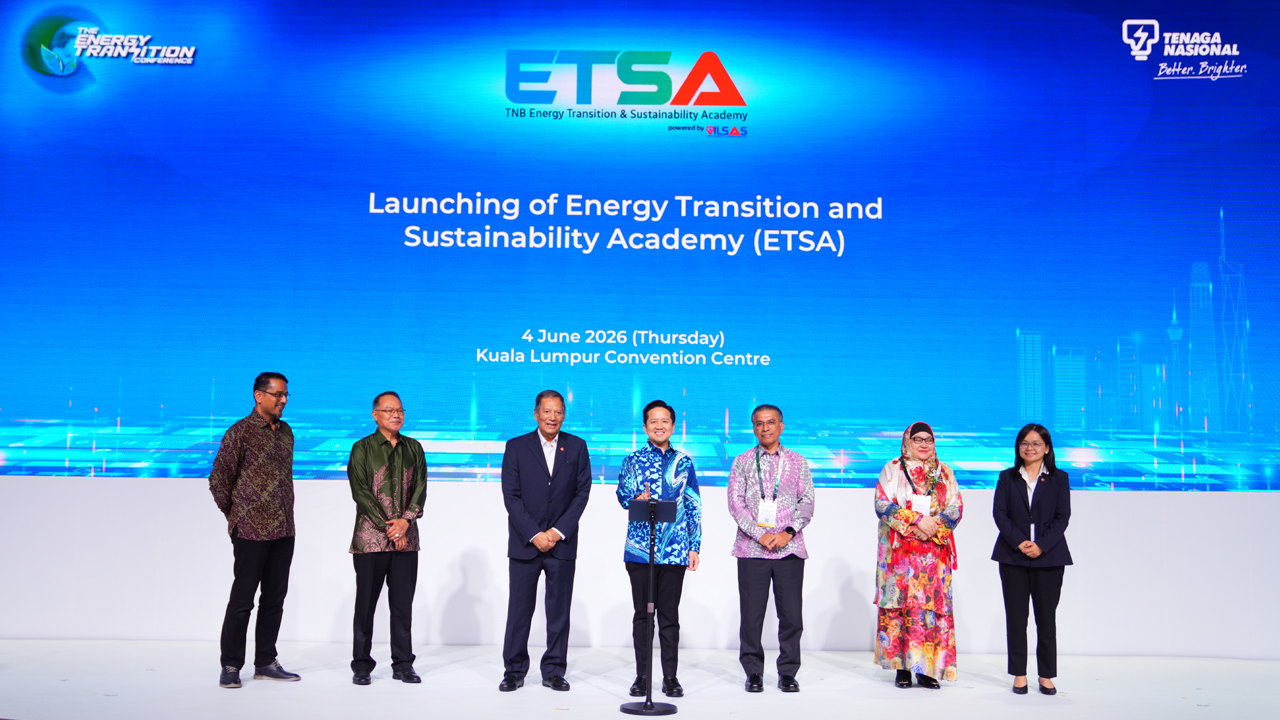
Figure 1: ETSA was officially launched at TNB’s Energy Transition Conference 2026, officiated by the Minister of Natural Resources and Environmental Sustainability.
Making sure the transition reaches everyone
A Just Transition must reach everyone, not only the engineers. That belief shapes how ETSA is built. Rather than reserving energy transition learning for technical specialists and sustainability practitioners, ETSA has mapped more than 35,000 employees into clear job groups and learner personas, spanning management, corporate functions, digital and ICT, engineering and operations, project teams, frontliners, academicians and trainers.
Every part of the organisation has a role to play in the transition, although the capabilities required may differ. An engineer may need to go deep on renewable generation, battery storage or emerging systems. Finance teams weigh transition-related risk and sustainable-financing opportunities. Procurement teams look for sustainability and resilience across suppliers and value chains. Frontliners need to understand new energy solutions well enough to explain them plainly to the customers who ask.
By tying learning to real roles and responsibilities, ETSA keeps capability from pooling in a small circle of experts. People from different backgrounds and levels of experience each build knowledge that is directly useful in their own work because no two employees start from the same place. Some already carry deep technical expertise; others are meeting these ideas for the first time. Personalised learning pathways let each person move from firm foundations toward more specialised, applied capability at their own pace.
Placing people within the capability framework
ETSA's capability framework is built around seven connected pillars: Energy Transition; Climate Risk and Resilience; Driving ESG Performance; Carbon and GHG Management; Sustainable Finance; People, Communities and Just Transition; and Sustainable Supply Chain and Market Enablement.
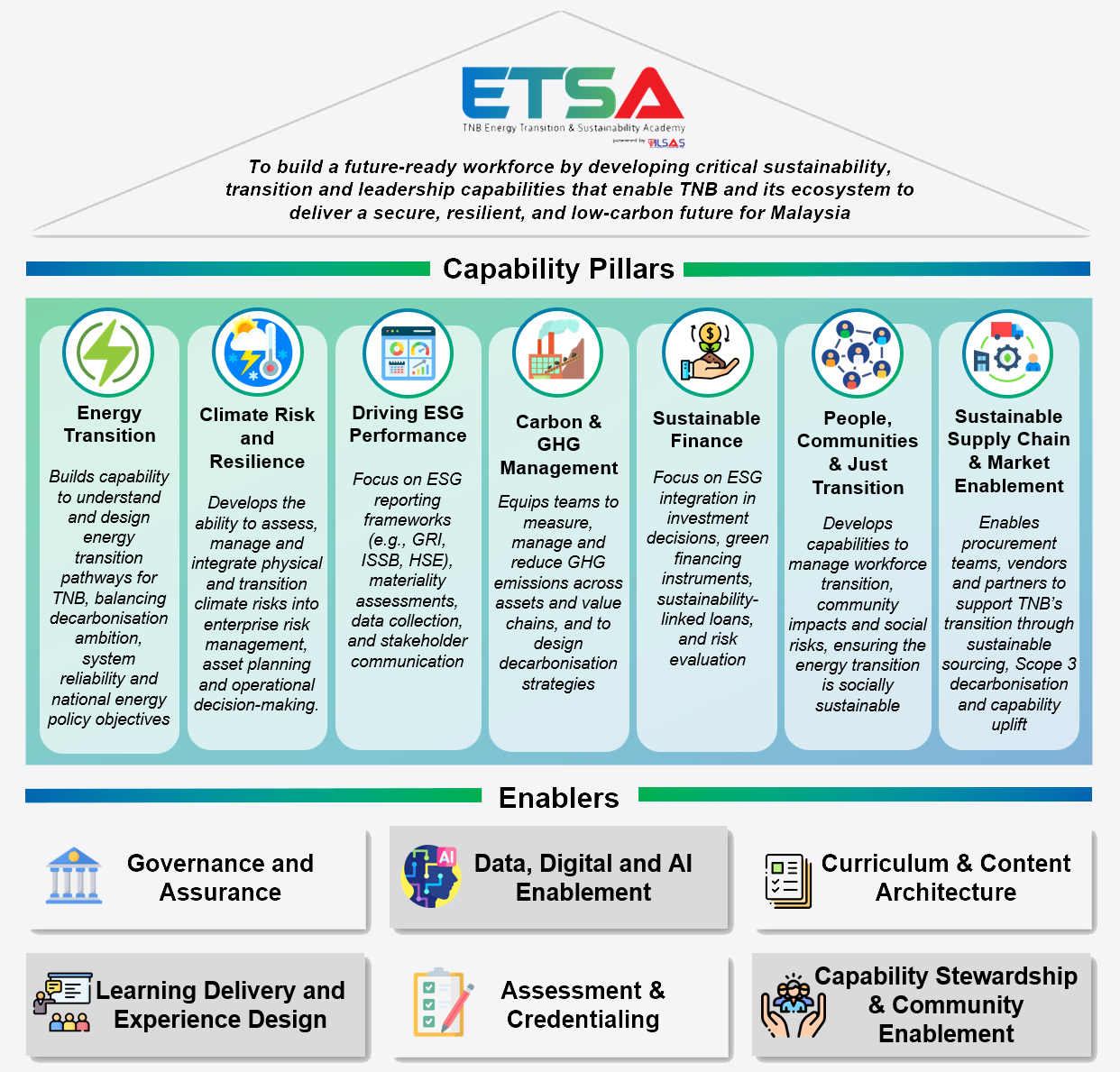
Figure 2: ETSA’s Capability Architecture
The decision to dedicate one of the seven pillars to People, Communities and Just Transition is deliberate: it says out loud that the energy transition is never only a technical or environmental exercise. This pillar builds the organisation’s ability to manage workforce transition, community impact and social risk, so that change is delivered in a way that is socially sustainable. It also complements the other six pillars by encouraging employees to consider the human implications of transition-related decisions alongside operational, financial and environmental considerations.
Together, the seven pillars give a fuller picture of what the transition asks of us. Technical knowledge remains important, but it must be supported by climate risk awareness, responsible financing, credible data, sustainable procurement and an understanding of how decisions may affect employees and communities.
Learning that meets people where they are
ETSA is designed around six ingredients: education, experience, exposure, environment, engagement and wellbeing, collectively known as its "5E and 1W" approach. In practice, that means role-based e-learning, accredited programmes, lively discussion, expert engagements, site visits, hands-on exercises and project-based learning, paced and supported so the experience stays inclusive and manageable.
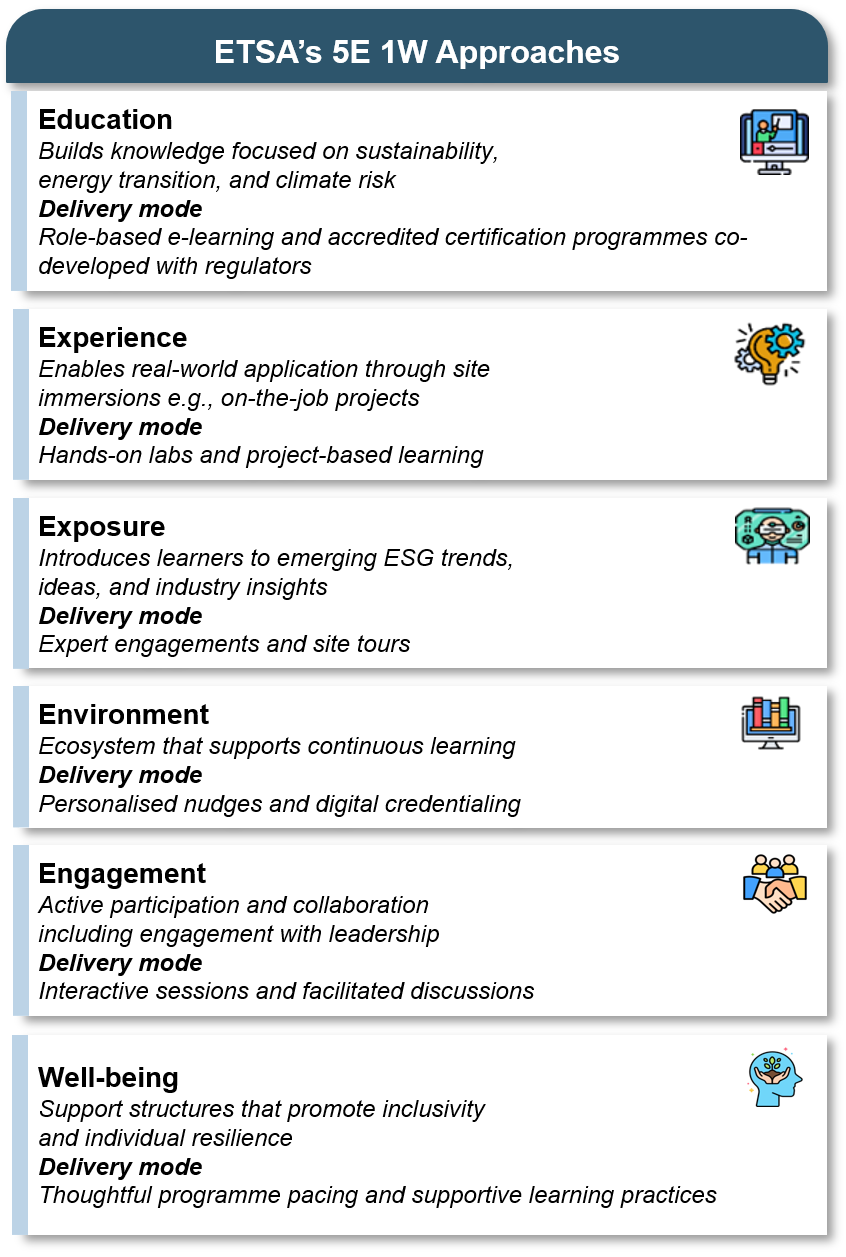
Figure 3: ETSA's 5E and 1W Approach
These elements move learning well beyond the classroom. Employees see how energy transition and sustainability actually show up in real assets, live projects and everyday business decisions, closing the gap between knowing about sustainability and being able to act on it when it counts.
We have already seen this tested in the room. Feedback from ETSA’s first train-the-trainer cohorts carried the kind of honesty that a genuine Just Transition invites: participants praised knowledgeable facilitators and hands-on exercises, and asked, candidly, for more time and gentler entry points for newcomers. In response, ETSA is building foundational, intermediate and advanced tiers into its curricula, demonstrating a willingness to meet people where they are rather than expecting everyone to progress at the same pace.
Skills for an evolving energy landscape
ETSA brings together a wide span of programmes, from established energy transition subjects to fast-emerging sustainability priorities. Its energy transition portfolio covers solar photovoltaics, hydrogen, bioenergy, electric vehicles, battery energy storage, carbon capture, energy management and green investment, with newer frontiers such as pumped-hydro storage, nuclear-energy foundations and regional power integration being introduced as TNB’s operating environment evolves.
Alongside these areas are programmes on greenhouse-gas emissions, climate resilience, sustainability reporting, biodiversity, sustainable supply chains, human rights, diversity and inclusion, sustainability-data management and transition-related finance. Each is structured across proficiency levels, allowing newcomers to start with the fundamentals while specialists and decision-makers progress towards deeper expertise.
Building capability from within
ETSA is also growing a community of internal trainers to keep learning alive across the organisation. Train-the-trainer sessions have been conducted in areas including greenhouse gas emissions and sustainable supply chain management. These sessions brought together participants from different parts of TNB and included practical exercises such as calculating Scope 1, Scope 2 and selected Scope 3 emissions, as well as applying sustainability considerations within procurement and supplier management.
Building internal trainer capability supports a longer-term approach to workforce development. It allows knowledge to be shared by employees who understand TNB's operations, challenges and business context, while creating a network that can continue to strengthen and update learning as transition priorities evolve.
Our plans go further still, deepening engagement with business entities, employee representatives and existing learning academies so that programmes stay tied to real workforce needs, and capability gaps surface through continued dialogue rather than a one-size-fits-all assumption.
Extending the impact beyond TNB
TNB employees remain the first focus, but ETSA’s ambition reaches into the wider energy ecosystem. Working with professional institutions and industry partners strengthens programme design, certification and the exchange of practical expertise. Partnerships with bodies such as the Asian Institute of Chartered Bankers (AICB) and the Malaysia Green Technology and Climate Change Corporation (MGTC) broaden capability development beyond traditional technical disciplines, from carbon market and green-skills development to the financial dimensions of the transition.
By opening its doors to corporates, financial institutions, suppliers and other ecosystem players, ETSA can help enlarge the national pool of talent capable of driving Malaysia’s energy transition. Knowledge flows both ways, from industry experts into TNB, and from TNB’s hard-won experience back out to the market. A pulse survey of business-unit representatives across TNB confirmed the direction has been set with strong validation of ETSA’s design, and clear appetite for practical, execution-focused learning that turns strategy into everyday action.
Moving forward, together
A Just Transition does not mean every employee ends up in the same role with the same skills. It means giving people a fair chance to understand the changes ahead, build capabilities that matter, and keep contributing as the organisation evolves. Through ETSA, TNB is drawing a clearer path for people to see where they fit in the energy transition and how their work helps carry it.
A successful transition will rest not only on what TNB builds, but on how ready its people are to lead, deliver and sustain the change. Through ETSA, TNB is taking practical steps to make sure the transition moves forward with its people, not ahead of them.