As Malaysia's national electricity utility, Tenaga Nasional Berhad (TNB) is working to reduce greenhouse gas (GHG) emissions beyond Scope 1. Improving energy efficiency within our own operations is equally important in managing Scope 2 emissions and supporting our broader decarbonisation commitments.
Scope 2 emissions are indirect emissions associated with purchased electricity consumed within TNB’s facilities and networks. These include electricity used in daily operations and electricity losses associated with transmission and distribution networks. Managing these emissions therefore requires a coordinated approach to reducing energy losses, improving operational energy efficiency and increasing the use of clean energy across our own operations.
To address these challenges, TNB has developed the Scope 2 Emissions and Energy Conservation Strategy to strengthen energy efficiency and conservation across its assets and operations, supporting the company's broader decarbonisation commitments.
A Structured Approach to Managing Scope 2 Emissions
TNB’s Scope 2 Emissions and Energy Conservation Strategy provides an overarching framework for managing electricity consumption and reducing associated GHG emissions across TNB's operations.
Building on the principles of demand-side management, the strategy extends energy efficiency considerations to TNB's own assets and facilities, enabling business entities to integrate relevant initiatives throughout asset planning, construction and operations.
The approach is organised around three strategic pillars:
Reduce Energy Losses
Minimising technical losses across electricity networks and equipment.
Reduce Energy Consumption
Improving energy efficiency and conservation across facilities, infrastructure and operational activities.
Produce Clean Energy
Increasing on-site renewable energy generation for self-consumption and reducing reliance on purchased grid electricity.
Supported by key enablers covering policy and governance, technology, financing, and communication and behaviour management, TNB adopts a comprehensive and systematic approach to carbon emissions mitigation through initiatives aimed at reducing energy losses, improving operational energy efficiency and optimising energy consumption across its operations.
TNB Scope 2 Emissions & Energy Conservation Strategy
- Adopt low-loss equipment design and specifications.
- Conduct loss identification, metering and baselining.
- Optimise network and equipment configuration.
- Strengthen monitoring and maintenance to minimise technical losses.
- Adopt energy-efficient design and specification.
- Conduct energy efficiency baselining.
- Implement formal Energy Management System
- Upgrade/retrofit existing assets with highly-efficient alternatives.
- Strengthen energy-efficient awareness and behavior management.
- Implement structural feasibility for on-site renewable energy integration during project.
- Maximize self-consumption of on-site generated clean energy (project site or operational asset)
- Continuously maintain and upgrade on-site renewable energy assets.
Figure 1: TNB Scope 2 Emissions & Energy Conservation Strategy
Reducing Energy Losses Across TNB's Network
Electricity transmission and distribution are central to TNB's operations. However, a proportion of electricity is inevitably lost as it passes through electrical networks and equipment. Reducing these technical losses is therefore an important part of improving network efficiency and managing Scope 2 emissions.
Under the strategy, TNB is implementing measures to minimise technical losses across its transmission and distribution infrastructure. These include upgrading overhead line conductors, balancing phase loading in low-voltage networks, installing capacitor banks and optimising 11 kV feeder configurations.
These initiatives are complemented by minimum loss-performance specifications for electrical equipment and improved reactive power management. Metering and asset-level monitoring also support the establishment of baselines and the assessment of the effectiveness of loss-reduction measures.
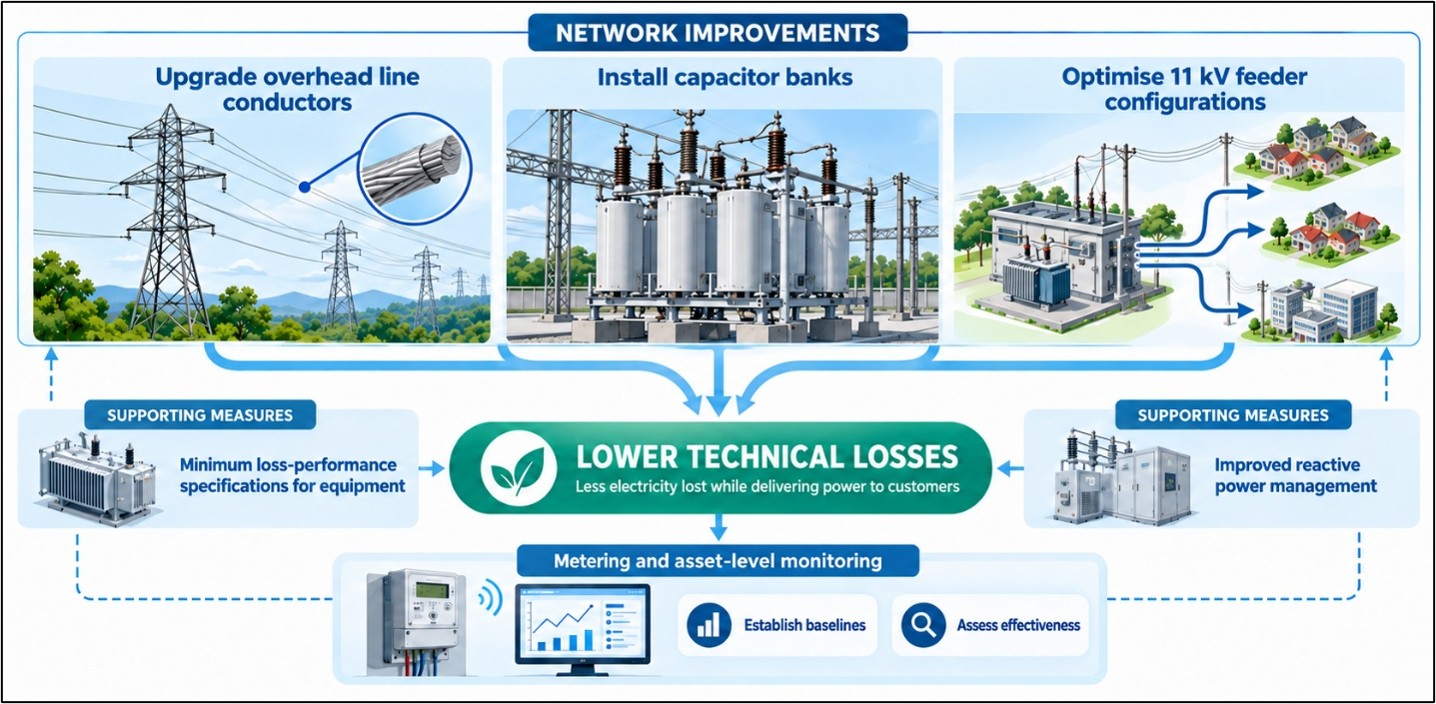
Figure 2: Key Initiatives to
Reduce Transmission and Distribution Losses
[AI-Generated Conceptual Illustration]
Progress is reflected in TNB's transmission and distribution (T&D) loss rate, which declined from 9.35% from January to August 2025 to 8.80% for the corresponding period in 2026. This represents a reduction of 0.55 percentage points, highlighting improvements in network efficiency alongside ongoing loss-reduction initiatives.
Beyond strengthening operational performance, reducing technical losses means that less electricity is lost in the process of delivering power to customers, supporting more efficient use of energy across the electricity supply chain.
Improving Energy Efficiency Within TNB's Facilities
Beyond its electricity networks, TNB is also addressing energy consumption across its buildings, facilities and operational assets. The focus is on reducing electricity demand without compromising safety, reliability or operational performance.
This begins at the asset development stage, where energy-efficient designs and specifications can help minimise electricity consumption over an asset's operational life. For existing facilities, initiatives include improving cooling systems, lighting and equipment efficiency, alongside optimising auxiliary loads during power plant outages.
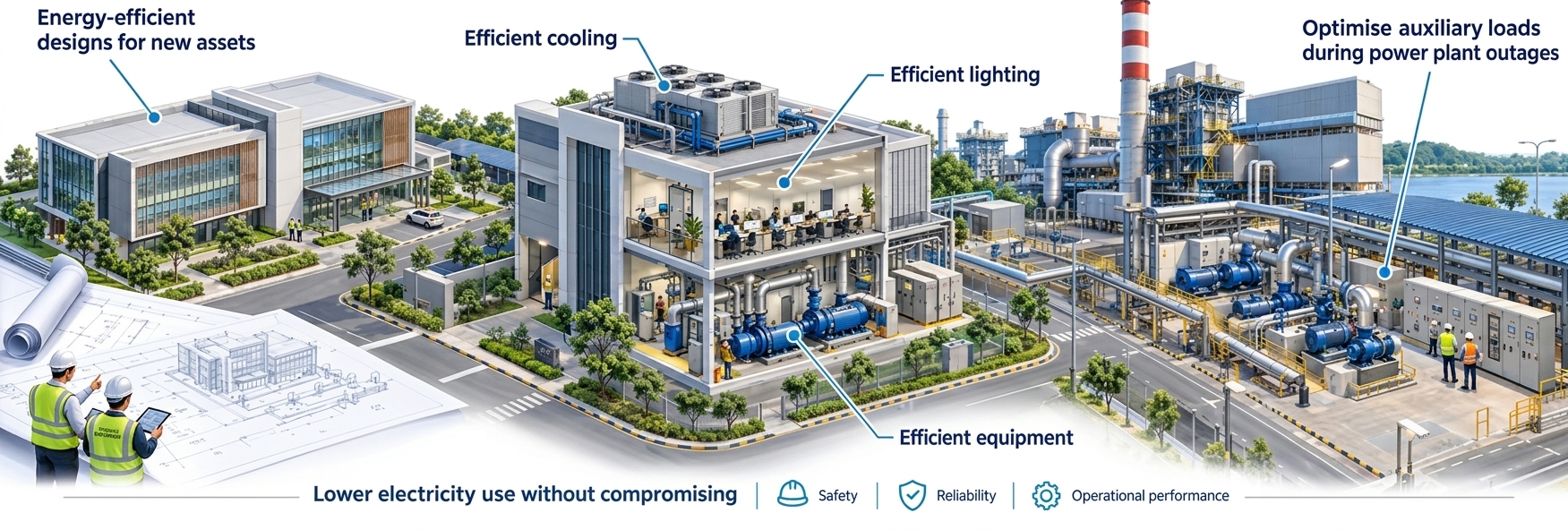
Figure 3: Key Initiatives to
Improve Operational Energy Efficiency
[AI-Generated Conceptual Illustration]
Building energy management forms another important component of this approach. Following the achievement of the Green Building Index (GBI) Platinum rating at TNB Platinum, efforts are under way to obtain green building certification for Bangunan Wilayah, with Bangunan Warisan identified as the next milestone.
At Universiti Tenaga Nasional (UNITEN), a campus-wide energy audit and a planned Energy Management System are also supporting efforts to identify electricity-saving opportunities and strengthen energy management practices.
Alongside infrastructure and operational improvements, employee participation plays a role in supporting energy conservation across TNB-owned offices.
Through the "Drip by Drip, Watt by Watt" campaign, employees are encouraged to adopt electricity conservation practices as part of their daily activities. Between January and August 2026, the campaign recorded 928,721 kWh in electricity savings with estimated Scope 2 emissions reductions of 731 tCO₂e, demonstrating how collective conservation efforts can contribute to reducing operational energy consumption.
These initiatives reflect TNB's approach to embedding energy efficiency across different levels of its operations, combining improvements in infrastructure and systems with everyday energy conservation practices.
Producing Clean Energy for TNB's Own Consumption
While reducing electricity losses and consumption remains important, TNB is also exploring opportunities to meet part of its operational energy demand through clean energy generated at its own facilities.
On-site renewable energy generation, particularly rooftop solar, allows electricity to be produced and consumed within the same facility, reducing the amount of electricity purchased from the grid and its associated Scope 2 emissions.
Rooftop solar initiatives are being explored across various TNB assets, including thermal power plants, control buildings at large-scale solar facilities, pump houses and high-consumption TNB buildings.
An example is the 208 kWp rooftop solar installation at Leo Moggie Convention Centre (LMCC), commissioned in September 2026.
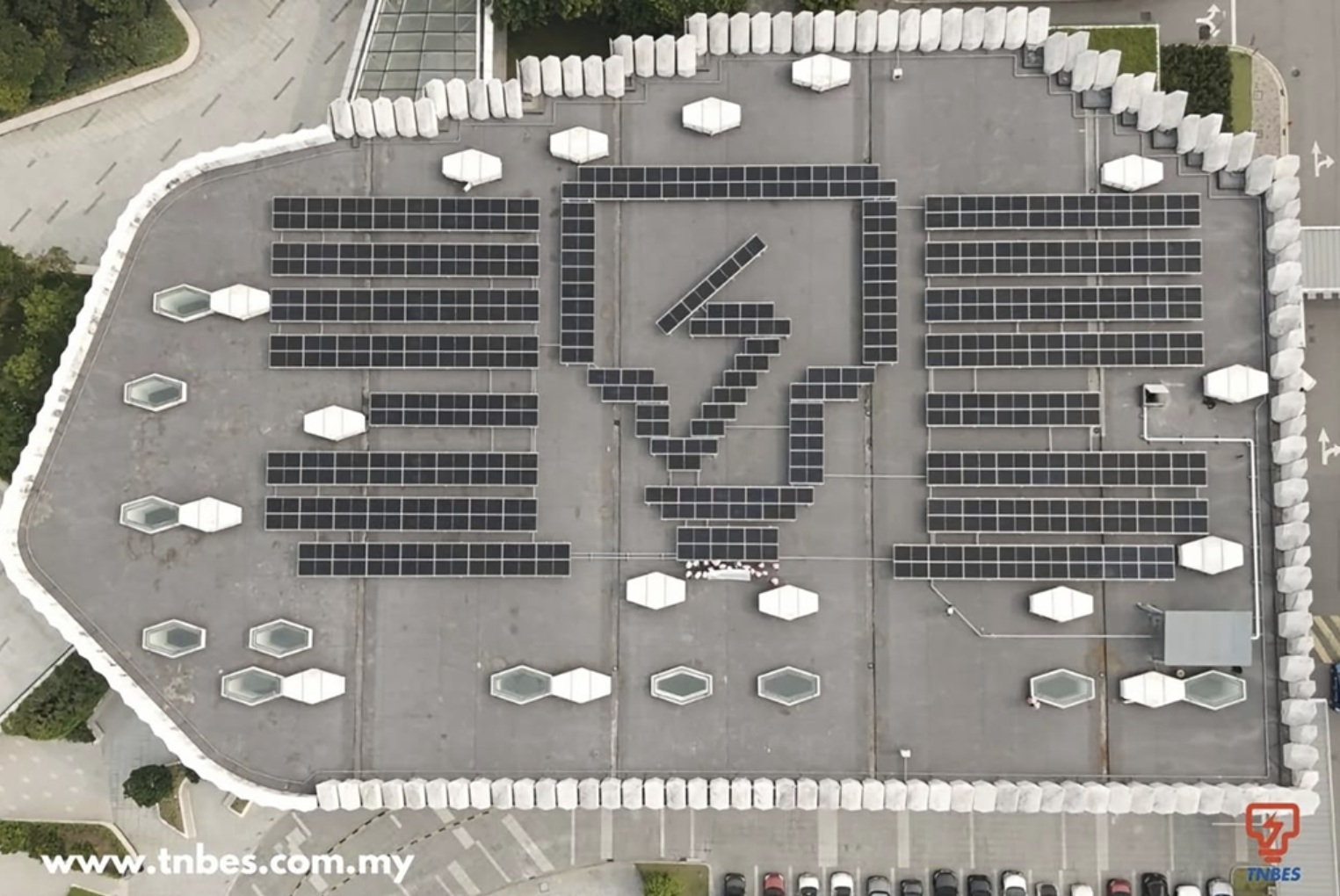
Figure 4: Rooftop Solar Installation at Leo Moggie Convention Centre (LMCC)
The installation generates approximately 21,840 kWh of electricity per month for self-consumption, reducing grid electricity purchases and avoiding an estimated 194 tCO₂e annually.
The LMCC installation demonstrates TNB's ongoing efforts to adopt cleaner energy sources through on-site renewable energy generation, reducing reliance on purchased grid electricity and mitigating associated Scope 2 emissions.
Measuring Progress in Reducing Scope 2 Emissions
To measure progress towards decarbonisation and assess the effectiveness of these initiatives, TNB has incorporated Scope 2 GHG emissions intensity as a key performance indicator within its strategy.
Measured in tonnes of carbon dioxide equivalent per megawatt-hour of electricity sold (tCO₂e/MWh), the indicator reflects Scope 2 emissions associated with TNB's operations and network losses for each unit of electricity sold to customers.
Using 2024 as the baseline year, with an emissions intensity of 0.038 tCO₂e/MWh, TNB has established targets to reduce Scope 2 GHG emissions intensity by 15% by 2030 and 25% by 2035.
These targets provide measurable milestones for the strategy, linking improvements in network efficiency, operational energy consumption and on-site clean energy generation to TNB's longer-term emissions reduction commitments, while supporting continued performance monitoring and implementation across the Group.
Bringing Energy Transition into TNB's Own Operations
For TNB, the energy transition extends beyond supporting the development of a cleaner electricity system. It also involves improving how electricity is managed and utilised within the company's own operations.
From reducing losses across transmission and distribution networks to strengthening building energy management, encouraging employee conservation practices and generating clean energy at its facilities, the Scope 2 Emissions & Energy Conservation Strategy brings these efforts together under a common direction.
Through continued implementation of the strategy and progress towards its 2030 and 2035 Scope 2 emissions intensity reduction targets, TNB is working to ensure that energy efficiency and conservation remain integral to how the company operates, while supporting Malaysia's wider energy transition.