The transition towards a more sustainable energy system is also about how electricity is used, and when it is used.
Every day, electricity demand rises and falls according to the routines of homes, businesses and communities. At certain times, many customers use electricity simultaneously, resulting in higher demand on the electricity system. At other times, demand is lower.
Managing this demand more effectively is an important part of building a more efficient and responsive electricity system.
Through the Time-of-Use (ToU) scheme, Tenaga Nasional Berhad (TNB) empowers eligible customers to take a more active role in managing when they use electricity.
Rather than applying the same electricity rate throughout the day, ToU offers different rates during peak and off-peak periods. Customers who are able to move energy-intensive activities to off-peak periods, can benefit from lower rates while supporting more efficient demand patterns across the electricity system.
In this way, ToU goes beyond tariff choice. It provides customers with a practical demand-side management option, encouraging greater awareness of their electricity consumption patterns and more deliberate decisions about when energy is used.
Managing Demand from the Customer Side
By providing a price signal between peak and off-peak periods, the ToU scheme encourages customers to understand their consumption patterns and consider whether certain activities can be shifted to periods of lower system demand.
Under Malaysia’s electricity tariff restructuring effective from 1 July 2025, the ToU scheme was revised to provide customers with a wider off-peak window.
For participating customers, off-peak rates apply from 10.00 p.m. to 2.00 p.m. from Monday to Friday, as well as throughout Saturdays and Sundays, as well as on 15 public holidays. Peak rates apply from 2.00 p.m. to 10.00 p.m. from Monday to Friday.
| Off-Peak | Peak |
|---|---|
| 10.00 p.m. to 2.00 p.m. Monday to Friday | 2.00 p.m. to 10.00 p.m. Monday to Friday |
| Throughout the day (24 hours) Saturday, Sunday & Public Holidays |
Table 1: ToU time zones
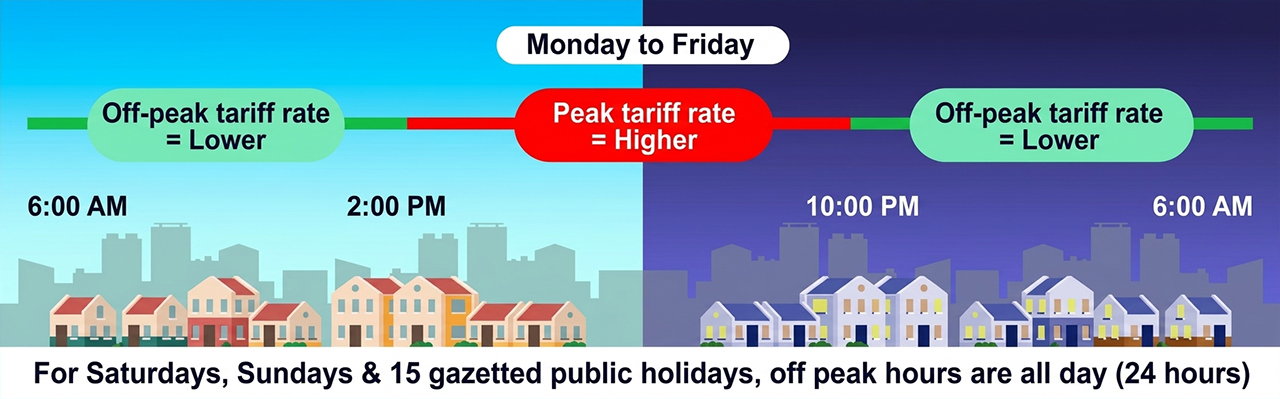
The wider off-peak period gives customers more flexibility to decide when certain energy-intensive activities can take place.
For households, this could include operating selected appliances outside peak periods or charging an electric vehicle after 10.00 p.m. For businesses, opportunities could include scheduling water pumping, fleet charging or selected energy intensive activities during off-peak periods where operationally practical.
-
EV charging
Shift charging to overnight hours to take advantage of off-peak rates.
-
Laundry or dishwashing
Run selected appliances during off-peak periods where suitable.
-
Electric water heating
Electric water heating Use lower rate periods where system settings allow.
-
Water pumping
Schedule pumping activities during off-peak hours where storage capacity is available.
-
EV fleet charging
Stagger charging schedules overnight to reduce peak period demand.
-
Flexible business operations
Schedule suitable energy intensive operations during lower demand periods, where operationally practical.
Table 2: Examples of usage that may be shifted to off-peak periods
The objective is not to prescribe how every customer should use electricity. Instead, it gives customers another option to make more informed choices about their own energy use.
A Green Option for Customers
From an ESG perspective, ToU is particularly relevant as an enabler of demand side management and more efficient energy consumption behaviour.
For customers who have flexibility in their daily routines or operations, the scheme provides an incentive to move suitable electricity consumption away from peak periods.
At the electricity system level, greater demand flexibility can help reduce the concentration of consumption during peak hours and support better load management.
Importantly, ToU should not be interpreted as automatically reducing every customer’s total electricity consumption. When customers consume approximately the same amount of electricity as in previous months, the scheme may generate bill savings for customers.
Its role is therefore broader. By encouraging customers to move energy-intensive electricity use away from peak periods, ToU provides TNB customers with a practical demand-side management option that supports more flexible and efficient energy consumption patterns.
Growing Customer Participation
Customer participation provides an early indication that more consumers are considering how the timing of electricity use can support better energy management.
From July 2025 to July 2026, approximately 217,000 customers switched to the ToU scheme. In an assessed sample of 83,163 domestic ToU customers, approximately 94% of customers in the assessed sample had more than 70% of their electricity use occurring during off-peak periods.
These findings indicate that customers are not only opting into ToU but are also making substantial use of the off-peak window where their consumption patterns allow.
This reinforces the role of ToU as a practical demand side management option that encourages greater awareness of when electricity is used and supports more flexible consumption patterns.
Review usage pattern
Shift suitable activities
Use off-peak periods
Monitor consumption through smart meter data
Manage electricity cost more consciously
Figure 1: How ToU supports smarter demand management
Smart Meters Enabling More Informed Choices
For customers to manage electricity use according to time, visibility of their consumption patterns is important.
Smart meters provide the foundation for this.
For domestic and non-domestic low voltage customers, smart meter installation supports participation in the expanded ToU scheme. Through time-based consumption information, customers can better understand how their electricity use changes throughout the day and assess whether ToU suits their household routines or business operations.
This also reflects a broader evolution in TNB’s relationship with customers.
Customers are no longer limited to receiving electricity and viewing their total consumption at the end of a billing period. Through smart meters, digital platforms and tariff options, customers are progressively gaining greater visibility over their electricity use and more ways to manage it.
TNB facilitates ToU applications and related customer support through channels such as the myTNB app and portal, Kedai Tenaga and TNB CareLine.
The combination of digital infrastructure and tariff choice therefore makes demand side energy management increasingly accessible to customers.
From Consumption Data to Better Energy Insights
TNB is also progressing to the next stage of customer experience.
Enhancements targeted for FY2027 are expected to provide customers with greater visibility of their ToU consumption trends through the myTNB portal, including insights into electricity usage and potential savings under the scheme.
Greater access to consumption insights can help customers understand when they use electricity, how much is consumed during peak and off-peak periods, whether their existing usage pattern is suitable for ToU, and where further adjustments may be practical.
For some customers, this may involve relatively simple changes such as overnight EV charging or scheduling selected appliances during off-peak periods. Businesses may identify different opportunities depending on their operating requirements.
What matters is that customers are increasingly equipped with information to make those decisions themselves.
Over time, the combination of smart meters, consumption insights and tariff options can help make energy management more practical and accessible.
Customers as Participants in Energy Transition
ToU brings together tariff design, smart-meter infrastructure, consumption insights and customer behaviour to support more informed energy choices.
For customers, it provides greater visibility and flexibility in managing when electricity is used. For the electricity system, greater participation in demand-side management can support more balanced and efficient demand patterns.
For TNB, this reflects a broader role in the energy transition: providing customers not only with reliable electricity, but also with options and information that enable them to manage energy more consciously and efficiently. Schemes like ToU provide opportunities to shape a more sustainable electricity system beyond power generation; they add a layer of intelligence to customer experience.
Eligible customers who wish to explore the ToU scheme may apply through the myTNB app and portal via the Time-of-Use (ToU) Application service. Customers are encouraged to review their usage patterns before applying to assess whether ToU is viable for their household routines or business operations. For more information, please visit myTNB website.