Every tonne of coal burned to generate electricity leaves something behind. For Tenaga Nasional Berhad (TNB), that residual, known as coal ash, has long been one of the most significant waste management challenges in its operations. But it is also becoming one of the most promising opportunities. Through a structured Waste Management Strategy (WMS) and a commitment to circular economy principles, TNB is progressively transforming coal ash from an industrial liability into a recoverable resource.
Coal ash, the residual material from coal-fired power generation, presents both an environmental challenge and a unique opportunity. As one of the largest contributors to TNB’s total industrial waste stream, coal ash accounts for approximately 97% of the hazardous waste generated. Managing it responsibly is essential to reducing our environmental footprint and reinforcing a waste management approach that increasingly recognises waste streams as potential resources within a circular economy.
Managing Coal Ash the TNB Way: From Waste to Resources
TNB’s approach to coal ash management is grounded in end-to-end waste management principles and regulatory compliance, ensuring that every step, from generation to end-of-life treatment, is safe, transparent, and environmentally sound.
To operationalise this approach, TNB applies the WMS, anchored to the following waste hierarchy:
| Waste Hierarchy | Definition | Applicability in TNB |
|---|---|---|
|
REDUCE |
Reduce waste directed to landfill. |
|
|
REUSE |
The practice of using items more than once in their original form to extend their lifespan, with no additional processing, for the same or a new purpose. |
Not applicable. |
|
RECYCLE |
Processing waste materials into new products or raw materials through mechanical or chemical methods. |
Recycling of coal ash into cement. |
|
RECOVERY |
Extraciting useful materials from waste, typically through processes such as material recovery, oil regeneration or chemical reclamation. |
Not applicable. |
|
SAFE DISPOSAL |
Controlled and responsible disposal of waste to approved landfill sites, ensuring it minimise risks to human health, animals or the environment. |
Safe disposal into ash pond. |
In practice, this means transforming coal ash from a disposal burden into an industrial input. For example, fly ash, which is a fine, powdery byproduct of combustion, is actively supplied to construction and cement partners.
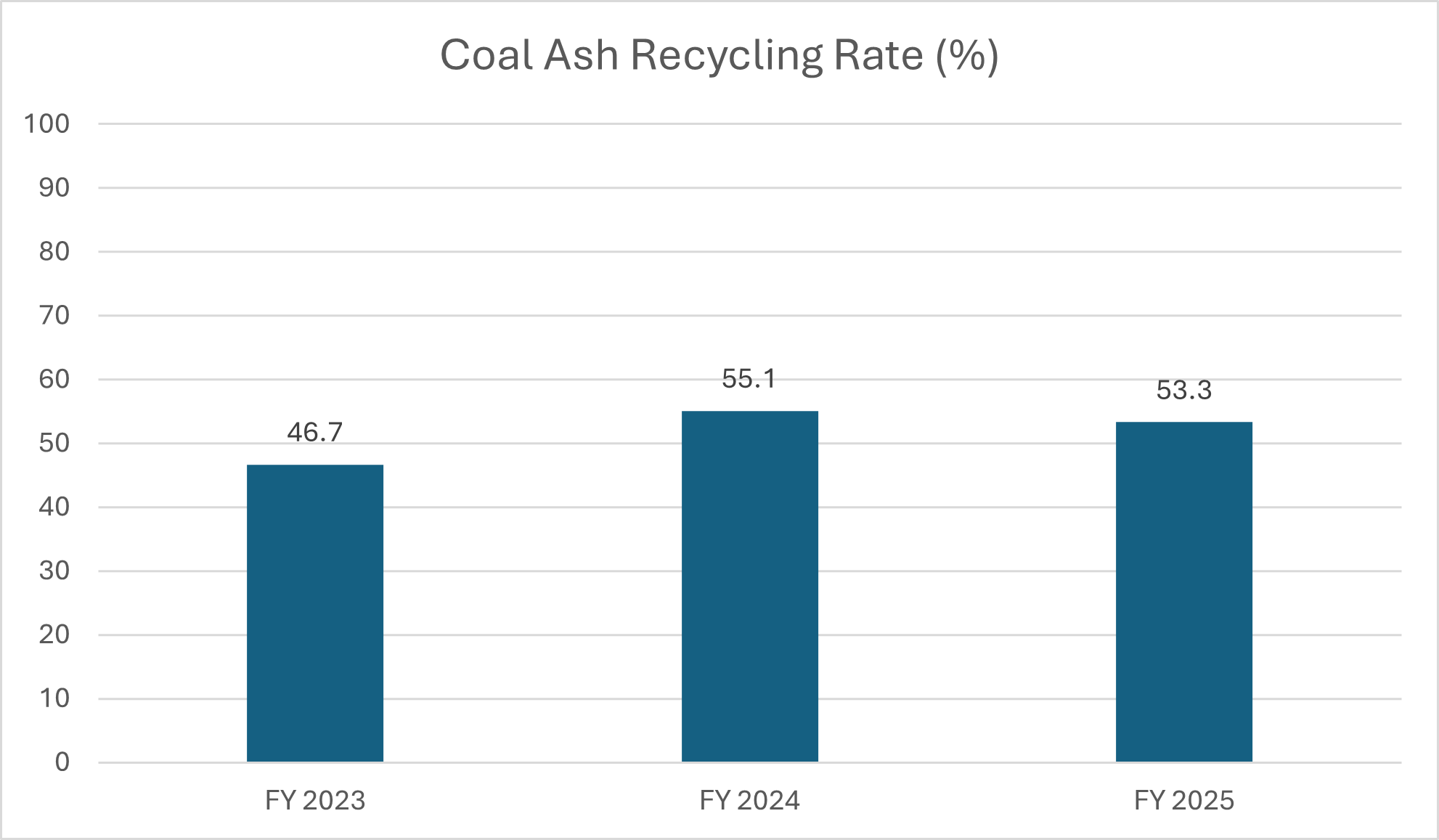
In 2025, TNB achieved an overall coal ash recycling rate of approximately 53%, reflecting a steady improvement from 47% in 2023. While this represents a slight decrease from the 55% recorded in 2024, the variation was primarily driven by higher overall coal ash generation during the year.
Notably, recycling performance for specific streams such as fly ash remained strong, with approximately 65% successfully channelled towards beneficial reuse, particularly in cement and construction applications. These outcomes demonstrate TNB’s continued efforts to sustain recycling performance while managing fluctuations in operational output.
To ensure full traceability and accountability, TNB’s ASH Management System digitally tracks coal ash from generation through to its final treatment or reuse. This system strengthens our compliance with the Environmental Quality (Scheduled Waste) Regulations 2005, supports accurate reporting, and enhances life cycle visibility.
Setting Clear Targets for Future Impact
TNB has embedded a coal ash management plan into a broader waste reduction and resource recovery roadmap, setting long term commitments to sustainable operations. The WMS establishes the following targets across all waste streams:
-
By2030
- Reduce total waste generated by 20% (from 2023 baseline)
- Maintain 50% annual recycling rate
-
By2035
- Reduce total waste generated by 50% (from 2023 baseline)
- Achieve a 60% annual recycling rate
To support these targets, TNB continues to undertake several coal ash-related initiatives, including:
-
- Phase down reliance on coal through strategic decommissioning and cleaner energy alternatives.
-
- Strengthen partnerships with cement producers and other end-users to expand and diversify coal ash recycling and utilisation pathways.
-
- Invest in research and innovation to enhance the quality and applicability of coal ash for high-value recycling.
-
- Enhance waste tracking, analytics, and digital controls to drive performance improvements.
Driving Impact: Transforming Challenges into Opportunities
At TNB, coal ash is increasingly managed not merely as a byproduct, but as a resource stream with broader potential for industrial application and environmental value. Through proactive management, digital monitoring, and targeted partnerships, TNB is reducing landfill dependence, lowering environmental risk, and unlocking new pathways for sustainable industrial materials.
These efforts also form part of TNB’s commitment to broader environmental stewardship, including responsible hazardous waste management and alignment with United Nations Sustainable Development Goal (SDG) 12 on Responsible Consumption and Production.
Looking Ahead: Sustainable Energy and a Circular Future
As TNB continues to progress along its Sustainability Pathway and Net Zero 2050 aspiration, efforts to strengthen coal ash management reflect a broader shift towards more integrated and responsible resource use across operations. By improving recycling performance, strengthening traceability, and expanding reuse pathways, TNB is progressively reducing environmental impact while supporting more circular industrial practices.
These ongoing efforts demonstrate how operational improvements, when applied consistently and at scale, can contribute meaningfully to both environmental stewardship and long-term system sustainability.